Hydra — Phase-Aware LLM Inference Characterization on Edge SoCs
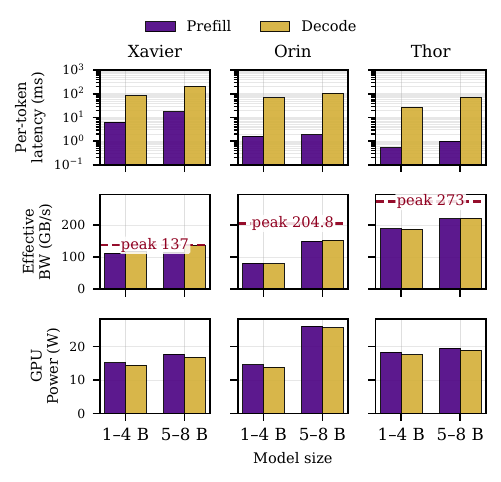
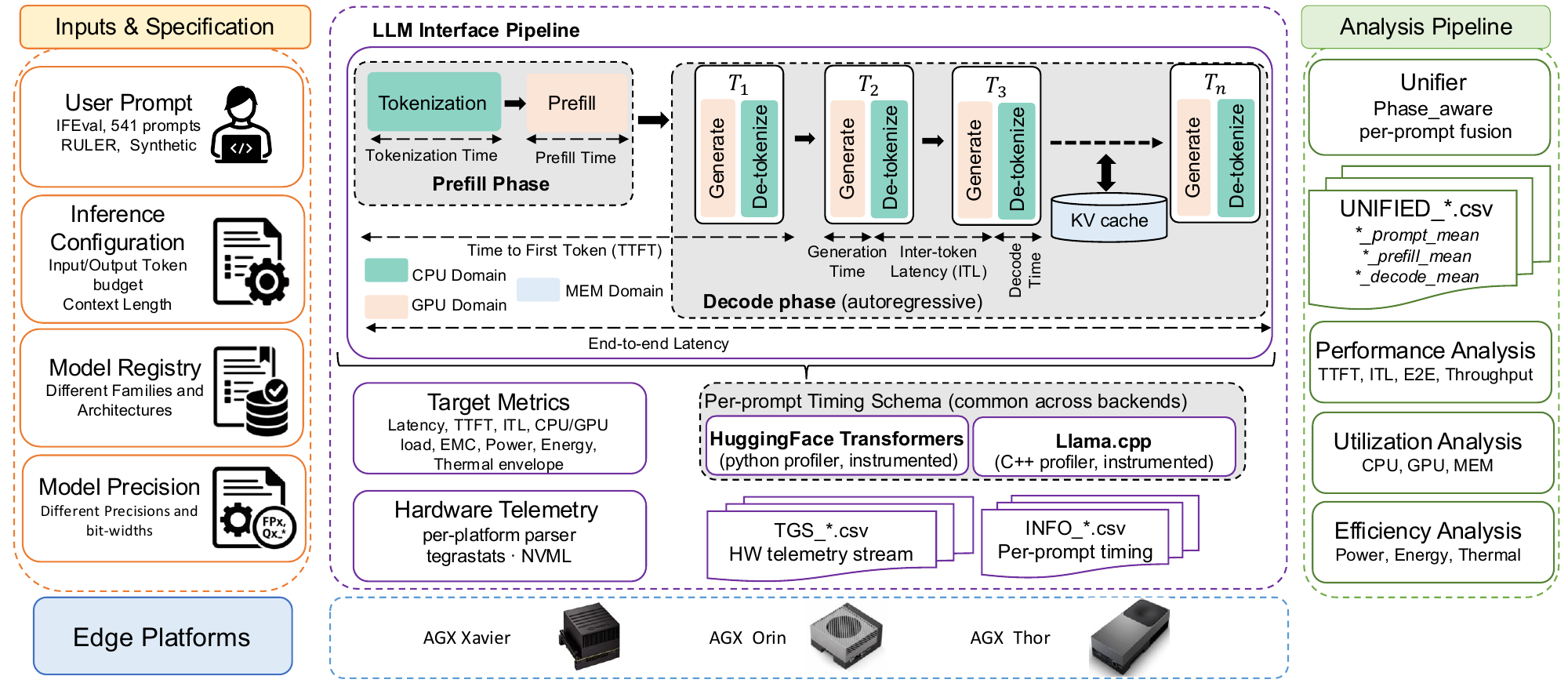
Hydra is a common-schema, phase-aware workload characterization framework for LLM inference on edge SoCs. It instruments two structurally different inference backends — HuggingFace Transformers (Python) and llama.cpp (C++/GGML) — with one per-prompt timing schema, fuses that timing with high-resolution tegrastats/NVML telemetry, and attributes CPU, GPU, memory, power, energy, and thermal behavior to the prefill and decode phases of every prompt. To appear at IISWC 2026 (Taherin et al., 2026) — see the publication page for the abstract and BibTeX.
Code and dataset
Both the framework and the full measurement corpus are openly available:
- Code — github.com/amirtaherin/hydra: the cross-backend profilers, telemetry fusion pipeline, canonical cross-platform schema, and analysis pipeline, organized after the paper’s architecture. One command (
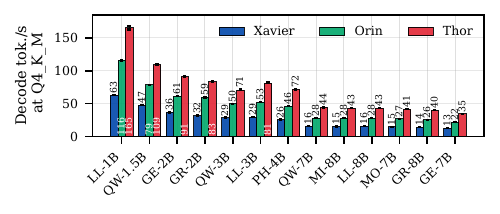
bash scripts/ae_reproduce.sh) verifies the shipped corpus and regenerates every data-derived figure and table of the paper on any Linux or macOS machine in about five minutes — no GPU required. - Dataset — archived on Zenodo, DOI 10.5281/zenodo.21844843: 107,110 per-prompt records covering three consecutive NVIDIA Jetson generations (AGX Xavier, Orin, Thor), 13 instruction-tuned LLMs from seven families, five execution formats (
bf16,F16,Q8_0,Q6_K,Q4_K_M), and input/output-length sensitivity sweeps — every telemetry signal phase-attributed to prefill and decode windows.
Selected results
Aggregate latency hides where time, power, and energy actually go. Three findings that only a phase-aware, cross-backend view exposes:
- A backend can win end-to-end while being slower per token. On Thor, HuggingFace generates a token in 33 ms but delivers it in 63.5 ms (CPU-side orchestration and de-tokenization); llama.cpp generates in 58.5 ms and delivers in 58.6 ms — runtime structure, not kernel speed, decides responsiveness.
- Power is not monotonic in bit-width.
Q6_Kdraws more power and runs hotter thanQ8_0on every platform measured — quantization format is a compute/memory tradeoff, not just a footprint knob. - The same utilization number means different things across SoC generations. An identical workload reads 27% GPU utilization on Orin and 86% on Thor because of DVFS policy — raw counters are not cross-platform comparable.